
Table of Contents
High frequency chest wall oscillation (HFCWO) therapy devices like The SmartVest Airway Clearance System help patients find relief from chronic pulmonary diseases like bronchiectasis and COPD (chronic obstructive pulmonary disease).
Through the use of vibrations and gentle pulses of air, HFCWO therapy helps manage respiratory and muscular conditions by loosening and thinning airway secretions to prevent mucus buildup in the lungs, which can lead to repeated inflammation and infections if the mucus is not cleared out.
Before HFCWO therapy, clinicians prescribed a more manual technique to help improve airway clearance, also known as chest percussion therapy (CPT). This article discusses how manual CPT paved the way toward HFCWO therapy and how SmartVest has been an important part of that journey!
The Origins of Chest Percussions
A Vienna physician named Leopold Auenbrugger von Auenbrugg was the first to coin the term “percussion” and administer this technique on a patient’s chest to identify the lungs’ positioning and presence of fluid.1 However, his procedure, first prescribed in 1761, gained little attention among fellow physicians.
It wasn’t until Jean-Nicolas Corvisart des Marest, a personal physician to Napoleon, translated his findings in 1808, outlining it as a technique to help diagnose certain lung conditions.2
Percussion therapy may date even farther back in history. Records indicate that in ancient Greece, physicians used such techniques on the abdomen area to distinguish between ascites (a condition where fluid collects in the abdomen) and meteorism (swelling caused by trapped air in the intestine).3
 Though chest percussion (i.e., tapping on the chest wall with the hand or a small medical instrument) was utilized as a diagnostic tool, it was also used as a therapeutic technique to help move mucus in the lungs, using a combination of hand strokes, repeated clapping on the chest wall, and shaking. This series of motions help loosen and mobilize thick secretions so they can be more easily cleared out of the lungs.
Today, manual CPT is used to treat pulmonary diseases such as bronchiectasis, COPD, cystic fibrosis, and pneumonia. It’s also combined with breathing exercises and postural drainage to maximize airway clearance.
Patients who rely on this type of airway clearance technique require the assistance of a caregiver or respiratory therapist to receive treatment, which must be performed multiple times a day, every day.
 The Origin of HFCWO Therapy
In the last several decades, advancements in medical technology have allowed manual CPT to become more precise and efficient through the use of machines that create high-frequency oscillations, which create a shearing effect in the airways to thin and loosen mucus without the help of a caregiver and without needing to switch positions to drain mucus once it is loosened.
In the 1980s, Warren Warwick, an American physician who worked primarily with cystic fibrosis patients, co-invented a mechanical device that patients wore to help loosen mucus, making it easier to cough mucus out of the lungs. The device was eventually named “The Vest.”4
After reading studies about the effectiveness of a blood-pressure cuff that inflated and deflated around a dog’s chest, thereby mobilizing its lung secretions, Warwick and his colleagues developed a vest with two hoses connected to a compressor, coming out at each side. The vest would pulse and vibrate to deliver the chest percussion at a consistently high frequency.5
The invention reduced reliance on manual CPT and allowed many patients to perform therapy independently.
Warwick’s invention caught the attention of other physicians, and pediatric and adult patients would use “The Vest” as part of airway clearance therapy in cystic fibrosis care.6
The History and Evolution of SmartVest
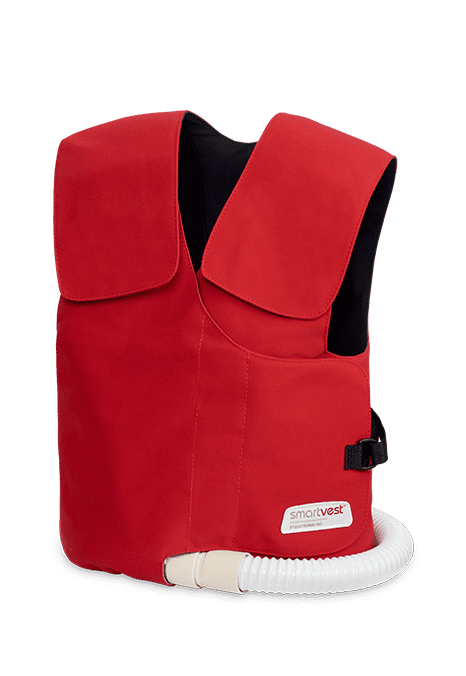
From its humble beginnings in 1992 to a publicly traded company today, SmartVest has experienced some memorable milestones that have allowed patients to take control of their chronic lung conditions and find relief from mucus buildup.
In 2000, Electromed, Inc. (makers of the SmartVest) introduced its first-ever portable HFCWO therapy device. The device allowed patients to plug in their chest percussion therapy vests and start receiving therapy at home.
A year later, the company launched the first machine-washable vest garment, making it easier for patients to clean and sanitize their SmartVest regularly to reduce the spread of germs.
In 2003, Electromed engineered its generator to be programmable, allowing patients to adjust each session to their comfort level. In addition, clinicians could easily adjust the prescribed therapy settings to suit each patient’s individual needs.
In 2007, the company introduced a multi-positional HFCWO therapy device, SmartVest® SV2100®, making it easier for patients to transport their generator easily and position it comfortably. During this year, Electromed also launched its reversible SmartVest® Wrap® garment for hospitals. The wrap made it more comfortable for patients to get on while lying down, especially for those hospitalized for a bronchiectasis flare-up.

In 2013, Electromed launched the SmartVest SQL®, an easy-to-use, smaller, quieter, and lighter generator that was even more portable.
In 2016, an independent peer-reviewed study was published in Respiratory Therapy on how SmartVest significantly reduced bronchiectasis-related healthcare utilization.7
In 2017, another independent study was published in Respiratory Therapy on how bronchiectasis patients saved up to 60% in healthcare expenditures by using SmartVest.8
In 2018, Electromed launched its SmartVest blog, an excellent resource for clinicians and patients with bronchiectasis, COPD (chronic obstructive pulmonary disease), asthma, and other respiratory conditions that impair breathing. The blog continues to publish recent news on bronchiectasis, tips for managing symptoms, and informative articles on chronic lung conditions to help educate and empower readers.
In 2019, a first-of-its-kind clinician study was published that demonstrated the effectiveness of SmartVest in reducing hospitalizations, decreasing antibiotic usage, and stabilizing lung function as part of an algorithm of care program.9
In 2020, Electromed introduced its patient care advocate program, which allows patients interested in learning more about SmartVest to schedule a chat with an experienced registered respiratory therapist to discuss their condition, how SmartVest works, and how to work with their healthcare team to obtain a device prescription.
In 2022, an independent, retrospective cohort analysis, patients with Non-Cystic Fibrosis Bronchiectasis (NCFB) who utilized HFCWO experienced improved health outcomes as well as a reduction in Healthcare Resource Utilization (HCRU) after HFCWO, as compared to before use.10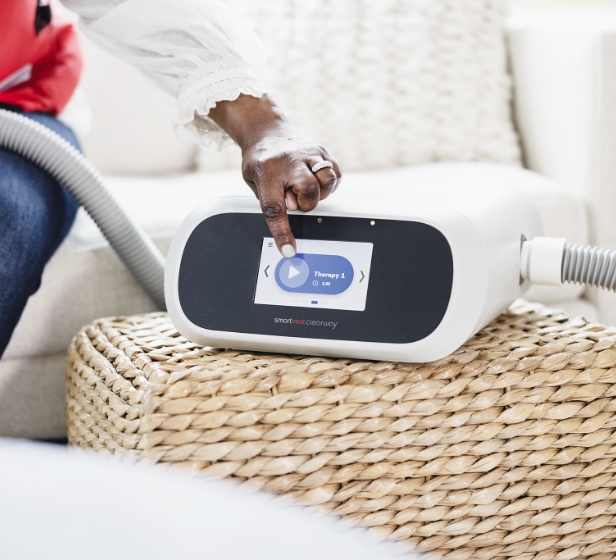
In 2023, Electromed introduced SmartVest® Clearway®, a small, portable HFCWO device featuring a modern design and an intuitive touchscreen.
Today, SmartVest continues to help patients manage their chronic lung conditions by delivering 360° chest coverage, more BREATHING ROOMTM (SmartVest releases 91% of air between compressions11), and an easy-to-use therapy.

The Future of Airway Clearance
As we head into another year, we look forward to serving the airway clearance needs of patients and clinicians with experienced customer care, lifetime support, clinical resources, and registered respiratory therapist training for new SmartVest users.
Above all, we aim to provide patients with the best HFCWO therapy device that makes life’s important moments possible—one breath at a time®.
To learn more about how SmartVest can help you or your patients you can request an informational packet or talk to us directly!
Experience airway clearance with SmartVest! Resources
- Britannica. “Leopold Auenbrugger von Auenbrugg.” Retrieved from https://www.britannica.com/biography/Leopold-Auenbrugger-von-Auenbrugg
- Britannica. “Leopold Auenbrugger von Auenbrugg.” Retrieved from https://www.britannica.com/biography/Leopold-Auenbrugger-von-Auenbrugg
- National Library of Medicine. “History of Chest Percussion.” Retrieved from https://pubmed.ncbi.nlm.nih.gov/11892364/
- The Cystic Fibrosis Foundation. “Warren Warwick, a Pioneer in CF Care and Research.” Retrieved from https://www.cff.org/community-posts/2016-02/warren-warwick-pioneer-cf-care-and-research
- The New Yorker. “The Bell Curve.” Retrieved from https://www.newyorker.com/magazine/2004/12/06/the-bell-curve
- The Cystic Fibrosis Foundation. “Warren Warwick, a Pioneer in CF Care and Research.” Retrieved from https://www.cff.org/community-posts/2016-02/warren-warwick-pioneer-cf-care-and-research
- Sievert, C, et al. Using High Frequency Chest Wall Oscillation in a Bronchiectasis Patient Population: An Outcomes-Based Case Review. Respiratory Therapy 11:4. 2016.
- Sievert, C, et al. Cost-Effective Analysis of Using High Frequency Chest Wall Oscillation (HFCWO) in Patients with Non-Cystic Fibrosis Bronchiectasis. Respiratory Therapy 12.1. 2017.
- Powner, J, et al. Employment of Algorithms of Care Including Chest Physiotherapy Results in Reduced Hospitalizations and Stability of Lung Function in Bronchiectasis. BMC Pulmonary Medicine, BioMed Central. 25 Apr. 2019.
- DeKoven M, Mandia K, DeFabis N, Chen J, Ruscio A. Patient characteristics, healthcare resource utilization and outcomes among non-cystic fibrosis bronchiectasis patients with high frequency chest wall oscillation (HFCWO) therapy. IQVIA PharMetrics Plus for MedTech. 2018-2019.
- Pokorney J. Comparison of Oscillatory Trough Pressure Generated by High Frequency Chest Wall Oscillation (HFCWO) Systems: A White Paper.